Beginner’s Guide: Your First Profitable Days
Start by treating the first East Dock days as a loop: buy only the ingredients your current task needs, fetch water, press fruit into concentrate, finish the drink with water, offer targeted free samples to unlock customers, wash every used cup, and pay rent before you chase upgrades. The Mixer comes after the first customer loop—not before.
The first-day loop in plain English
Your early business has more moving parts than the premise suggests. You are not simply putting fruit into one machine and collecting money. The launch-week footage consistently shows a chain of ingredient → concentrate → finished drink → customer match → dirty cup → cleanup → next day.
- Buy the requested fruit. Orange and lemon are the important first examples in the tutorial footage.
- Draw water from the village well. Both the finishing process and cup washing depend on water, so running dry creates two problems at once.
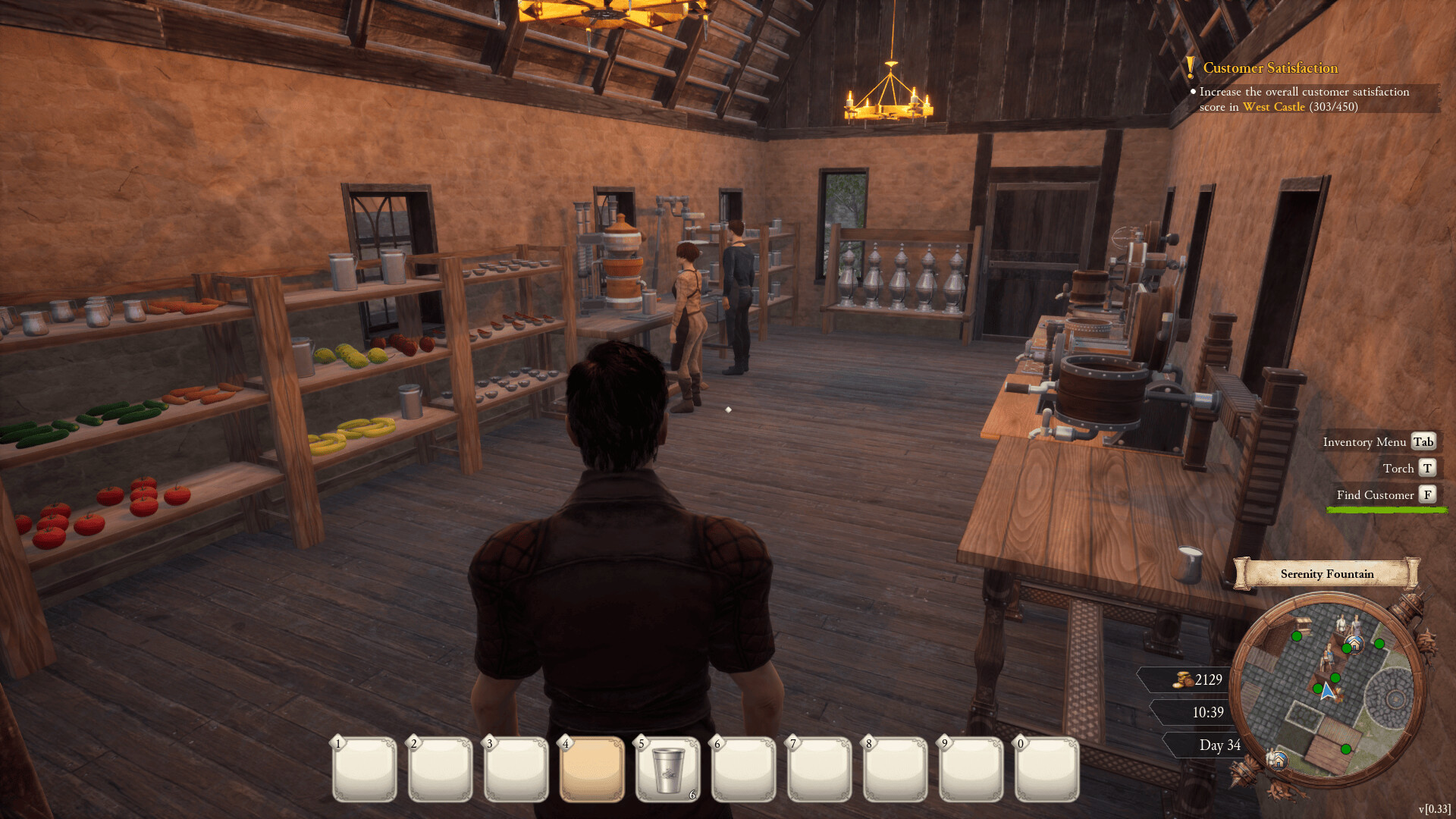
- Use the Citrus Juicer to make concentrate. The juicer is the first processing step for citrus fruit.
- Use the Final Station with water to produce a drink you can carry and sell. Think of concentrate as an intermediate product, not the final sale item.
- Offer free samples only to good prospects. A successful sample can turn a potential customer into somebody who buys from you later.
- Wash used cups. Several videos hit this wall because selling stops when the clean-cup supply is exhausted.
- Pay rent and read your mail before sleeping. Grandpa’s letters are part of progression and machine unlocks.

What should I spend money on first?
Spend for the current objective, not for a fantasy version of the shop you do not have yet. Early cash is tight because ingredients, rent, cups and machines all compete for the same gold. A safe order is:
| Need | Why it comes first |
|---|---|
| Required fruit + water | No drink means no customers or income. |
| Rent buffer | Missing rent can eventually remove you from the property. |
| Clean cups / washing capacity | A full tank is useless if you cannot serve it. |
| Mixer when the quest unlocks it | It opens sweetened/herbal combinations and more preference matches. |
| Extra tank / shelf capacity | Useful after you can reliably sell more than one recipe. |
Do not buy broad stocks of every ingredient just because they are visible. Customer preferences become more valuable once you can track and inspect them.
Free samples are not wasted juice
Free samples are a customer-acquisition mechanic. A customer who accepts the right sample can become a repeat buyer, and the customer list then becomes your planning board. This is why the beginner route prioritizes matching over randomly handing out the first juice you made.
If a sample does not convert somebody, check two things before blaming the game: whether the NPC lives in the current village, and whether the drink matches enough of that person’s known preferences. Some NPCs also gate interaction behind village reputation.
The first three problems worth solving immediately
“My tank has the wrong juice in it.”
Use the Products screen rather than trying to pour the tank out in the world. The official two-step empty-tank solution is in the dedicated empty juice tank guide.
“I cannot find the customer the quest wants.”
Open Inventory → Customers, select the NPC, and use the Track control. The tutorial explicitly walks through tracking Maximus the Tinsmith this way. The customer guide explains the icons and the Find Customer flow.
“I have juice but cannot sell it.”
Check clean cups first. Then check the customer’s preference and whether that NPC is available in this village. A full production line does not bypass the serving rules.
When should I buy the Mixer?
Buy it when the progression objective points you to Harry the Carpenter. Launch-week footage shows the Mixer as the next meaningful machine after basic citrus production. It lets you combine juice concentrate with ingredients such as sugar, herbs or spices before the final-water step. That is what turns a basic sour lemon drink into combinations that can satisfy customers such as Maximus, who is shown wanting Sweet + Energy Booster.
See Mixer guide for the exact order of operations.
A good end-of-day checklist
- Is rent paid or safely buffered?
- Did you wash the cups you used?
- Did you read new mail?
- Do you know tomorrow’s target customer before buying ingredients?
- Is the tank holding a drink you can actually sell?
- If not, empty it before spending on a new batch.
That checklist keeps the business from turning into the common early-game mess: plenty of ingredients, no clean cups, the wrong tank contents, and no cash left for the task that actually advances progression.