
Recipes & Effects Guide
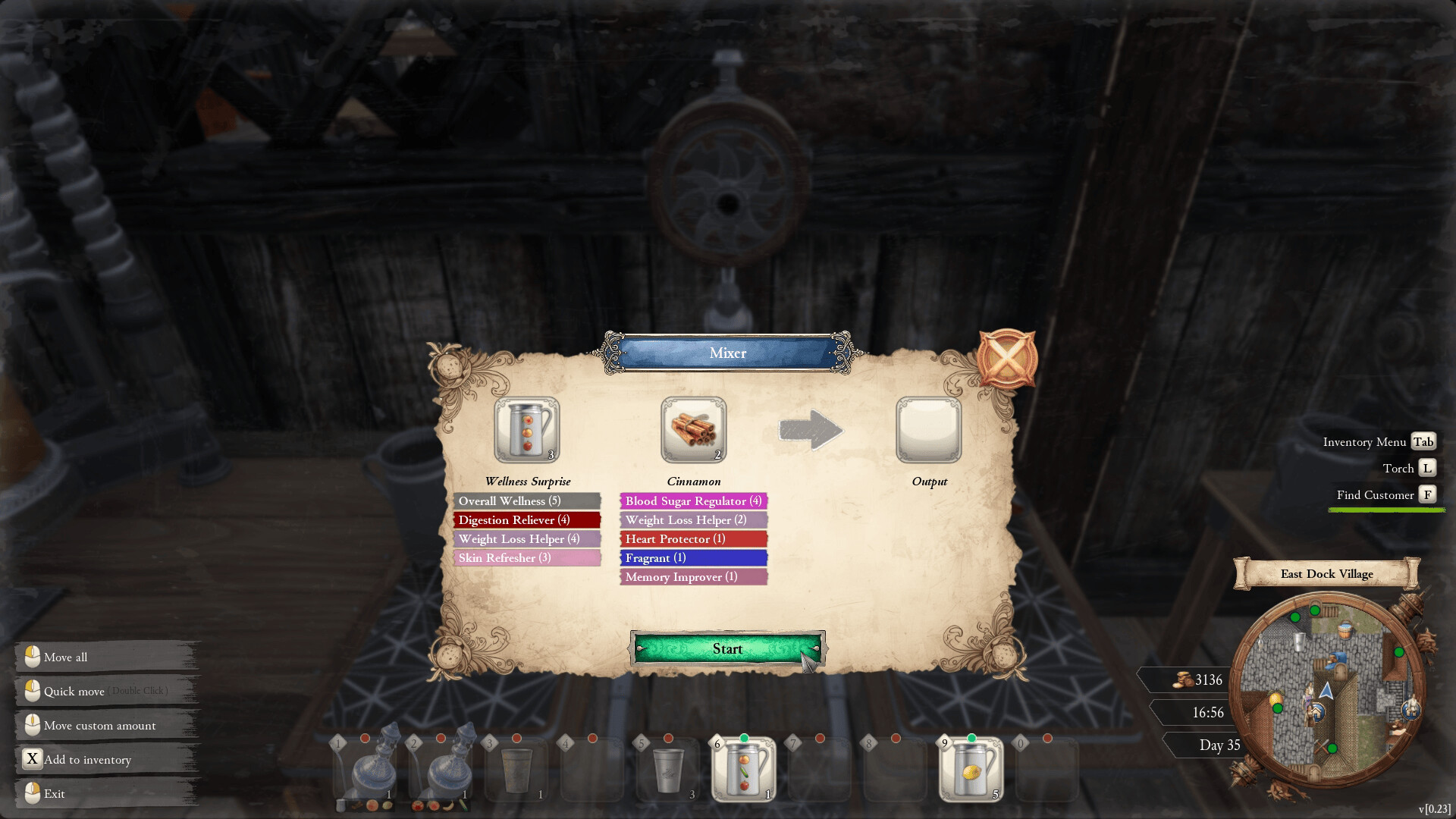
Recipes are built in stages. First turn the base ingredient into juice concentrate, then use the Mixer for additives such as sugar, mint, herbs or spices, and finally use the Final Station with water to make the sellable drink. Customer matching cares about the drink’s resulting taste and effect tags—not just the fruit name.
The recipe pipeline
The most useful mental model is base → modifier → finish → customer.
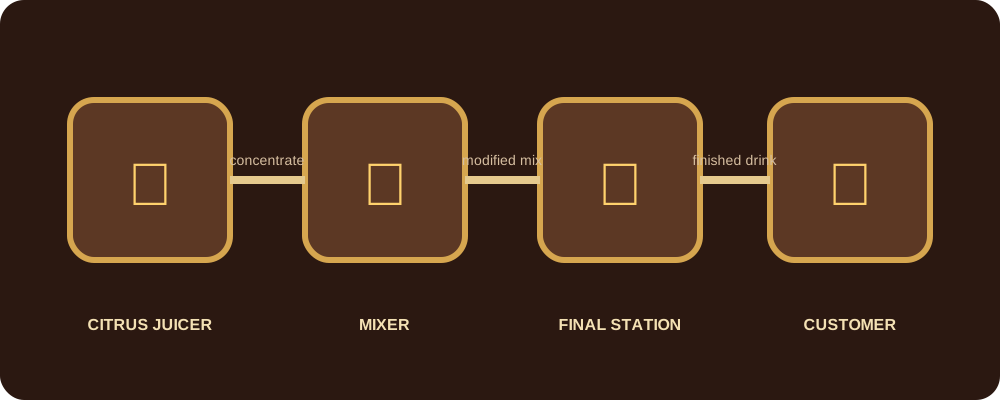
| Stage | What happens | Early example |
|---|---|---|
| Base press | Fruit becomes concentrate | Lemon → lemon concentrate |
| Mixer | Add sugar/herb/spice to the concentrate | Lemon concentrate + sugar |
| Final Station | Add water and finish the batch | Sweet + sour lemon drink |
| Customer match | Compare taste/effect tags with preferences | Maximus accepts a matching batch |
The subtitles show a lemon + sugar batch finishing with Sweet + Sour, and another launch-week sequence identifies that batch as also carrying an Energy Booster effect. Those tags are what make it useful to Maximus.
Early-game combinations to try
This is deliberately not labeled “all recipes.” The supplied footage is deep but not a complete database of every launch-version combination.
| Combination | What the footage supports | Confidence |
|---|---|---|
| Lemon | Basic sour citrus drink; used for early customers | High |
| Lemon + Sugar | Sweet + Sour after mixing and finishing | High |
| Lemon + Mint + Sugar | A multi-additive sequence is shown; add ingredients through the Mixer in steps | High for method, partial for final tags |
| Orange + Mint | Appears as a customer-preference combination | Medium; the full effect set is still unknown |
The official Steam description confirms a much broader ingredient system—fruit, vegetables, flowers, spices, herbs, sugar, milk and yogurt—and effects such as immunity and hydration boosts. That means the correct long-term strategy is to index result tags, not just ingredient names.
Why does my mixed recipe not work?
The Mixer is not the last station. If you have a mixed concentrate but no sellable batch, move it into the Final Station, add the required water, and complete the finishing step. Several long-form videos pause at exactly this point because the intermediate mixture looks finished but is not yet in a customer-ready form.
Also remember that the Mixer may accept one additive step at a time. In a lemon + mint + sugar sequence, the footage shows the player adding mint, taking the mixture out, then continuing the process rather than dropping everything into a single magical slot.
Taste tags and effect tags are separate
A customer can want a taste, an effect, an ingredient, or a combination. Maximus is the clearest launch-week example: Sweet + Energy Booster. A drink can satisfy him even if it also carries Sour, as long as the wanted tags are present.
That is why “best recipe” is the wrong universal question. The better question is: what is the cheapest recipe I can currently make that satisfies this customer’s known tags? Use the Customer & Recipe Matcher for the early-game rows available today.
Efficient recipe testing
- Track one potential customer before buying ingredients.
- Note every known preference in the customer panel.
- Pick the simplest available ingredient path that can hit those tags.
- Make a small batch before filling every tank.
- Offer the sample and check whether the preference panel reveals more information afterward.
- Record the successful combination for future days.
This keeps experimentation cheap and turns customer discovery into a repeatable business process instead of random mixing.